Composition, Inheritance, and Class-Level Features
Composition:组合复用
组合的语义:has-a
组合(composition)指:
用已有对象作为字段,构造出一个新对象。
它表达的是:
has-a,即“有一个”。
典型例子:
car has an enginecar has tyresSavingsAccount has a PersonSavingsAccount has a Currency
如果一句话念出来是通顺的 “A has a B”,通常就应该先考虑组合。
Effective C++ Item 38 的观点:
- 在应用领域里,composition 常表示 has-a;
- 在实现领域里,composition 也可以表示 is-implemented-in-terms-of。
所以,很多时候如果只是想复用某个类的内部实现,更适合用组合,而不是公有继承。
两种组合方式
组合主要有两种方式:
| 方式 | 英文 | 成员写法 | 语义 |
|---|---|---|---|
| 直接拥有 | Direct, owns | Y y; | X 拥有 Y,生命周期绑定 |
| 间接引用 / 共享 | By reference, shares | Y* p; / Y& r; | X 指向 / 借用 / 共享外部 Y |
直接拥有
字段直接是对象本身:
class X {private: Y y1, y2;};含义:
X直接拥有这些Y对象;X的生命周期结束,这些Y成员对象也会结束;- 绑定关系紧密;
- 适合表示真正属于对象内部状态的部分。
例如,一个 Employee 的下面这些信息通常和员工对象绑定紧密:
NameAddressHealth PlanSalary History
它们适合被 Employee 直接拥有。
间接引用 / 共享
字段存的是指针或引用:
class X {private: Y* p1; Y* p2; Y& r1; Y& r2;};含义:
X不一定拥有这些Y对象;- 更像“引用 / 借用 / 指向 / 共享”;
- 生命周期管理可能不归
X全权负责; - 适合表示外部已有对象之间的关联。
例如 Employee 的 Supervisor 虽然也和员工相关,但 supervisor 本身也是另一个 Employee。此时更合理的实现通常是指针或引用:
class Employee {private: // Name, Address, HealthPlan, SalaryHistory 可以直接拥有 Employee* supervisor; // 指向另一个 Employee,不直接拥有};组合对象的初始化
组合对象本质上也是成员字段,所以应该在 constructor initializer list(构造函数初始化列表) 中完成初始化。
例子:
class Person { /* ... */ };class Currency { /* ... */ };
class SavingsAccount {public: SavingsAccount(const string& name, const string& address, int cents); ~SavingsAccount(); void print();private: Person m_saver; Currency m_balance;};构造函数应该写成:
SavingsAccount::SavingsAccount(const string& name, const string& address, int cents) : m_saver(name, address), m_balance(0, cents){}这里的含义是:
m_saver(name, address)调用Person的构造函数;m_balance(0, cents)调用Currency的构造函数;- 初始化列表把参数直接传给成员对象的子构造函数。
不推荐的写法
SavingsAccount::SavingsAccount(const string& name, const string& address, int cents) { m_saver.set_name(name); m_saver.set_address(address); m_balance.set_cents(cents);}问题:
- 进入构造函数体之前,
m_saver和m_balance已经被默认构造了; - 函数体里再调用
set_...,本质是“先默认初始化,再赋值修改”; - 如果成员对象没有默认构造函数,这种写法会直接编译失败;
- 即使能编译,语义和效率也更差。
结论:成员对象需要构造参数时,应优先使用初始化列表。
组合后的函数实现:把工作转派出去
组合以后,不应该越过抽象边界去读取被组合对象的内部数据。更好的做法是:
把任务转派给真正负责该信息的对象。
例如 SavingsAccount::print():
void SavingsAccount::print(){ m_saver.print(); m_balance.print();}这段代码的设计含义:
m_saver自己知道怎么打印Person信息;m_balance自己知道怎么打印Currency信息;SavingsAccount只负责组织整体流程。
不推荐的思路:
- 直接伸手去读
m_saver内部每个字段; - 在
SavingsAccount里重新拼一遍Person的打印逻辑; - 破坏封装,使得
Person内部结构一变,SavingsAccount也要跟着改。
组合的正确使用方式包括:
- 保持抽象边界;
- 通过公开接口协作;
- 把职责分派给真正拥有该数据的对象。
Inheritance:继承复用
继承的语义:is-a
继承(inheritance)表示:
一个类是另一个类的一种特殊形式。
它表达的是:
is-a,即“是一个”。
典型例子:
Student is a PersonProfessor is a PersonManager is an Employee
如果这句话说得通,那么继承才有语义基础。
| 关系 | 判断句式 | 例子 |
|---|---|---|
| composition | A has a B | Car has an engine |
| inheritance | A is a B | Manager is an Employee |
基类 / 派生类术语
| 英文 | 中文 | 说明 |
|---|---|---|
| Base class | 基类 | 被继承的类 |
| Super class | 超类 | 同 base class |
| Parent class | 父类 | 同 base class |
| Derived class | 派生类 | 继承别人的类 |
| Sub class | 子类 | 同 derived class |
| Child class | 子类 | 同 derived class |
例如:
class Employee { // ...};
class Manager : public Employee { // ...};这里:
Employee是 base class / parent class;Manager是 derived class / child class。
Employee / Manager 例子
声明基类 Employee
class Employee {public: Employee(const string& name, const string& ssn); const string& get_name() const; void print(ostream& out) const; void print(ostream& out, const string& msg) const;protected: string m_name; string m_ssn;};这里要注意:
m_name和m_ssn被声明为protected;- 派生类可以直接访问
protected成员; - 类外仍然不能直接访问。
protected 的完整规则放在后面的 Access protection 中统一讲。
Employee 构造函数
Employee::Employee(const string& name, const string& ssn) : m_name(name), m_ssn(ssn){ // initializer list sets up the values!}这里依然使用初始化列表,因为 m_name 和 m_ssn 是成员字段,应在构造阶段完成初始化。
Employee 成员函数
const string& Employee::get_name() const{ return m_name;}
void Employee::print(ostream& out) const{ out << m_name << endl; out << m_ssn << endl;}
void Employee::print(ostream& out, const string& msg) const{ out << msg << endl; print(out);}这里有两个 print,构成重载:
void print(ostream& out) const;void print(ostream& out, const string& msg) const;后面会看到,派生类中重新定义同名 print 时,会触发 name hiding。
声明派生类 Manager
class Manager : public Employee {public: Manager(const string& name, const string& ssn, const string& title); const string title_name() const; const string& get_title() const; void print(ostream& out) const;private: string m_title;};这里:
Manager : public Employee表示公有继承;Manager继承了Employee的接口和实现;Manager自己新增了m_title。
继承中的构造与析构顺序
派生类构造函数写法:
Manager::Manager(const string& name, const string& ssn, const string& title) : Employee(name, ssn), m_title(title){}这里的 Employee(name, ssn) 表示:
先调用基类
Employee的构造函数,构造出派生类对象内部的基类子对象。
可以把派生类对象理解成:
Manager object├── Employee base subobject│ ├── m_name│ └── m_ssn└── Manager's own part └── m_title构造顺序:
Base class→ Derived class's member fields→ Derived class constructor body也就是:
Employee(name, ssn)→ m_title(title)→ Manager constructor body如果没有显式给基类传参:
Manager::Manager(...) : m_title(title) {}编译器会尝试调用 Employee 的默认构造函数。若 Employee 没有默认构造函数,会编译失败。
析构顺序与构造顺序严格相反:
Derived class destructor body→ Derived class's member fields→ Base class构造从上到下,析构从下到上。
继承后的成员访问与复用
派生类可以复用基类已经写好的成员函数。
void Manager::print(ostream& out) const{ Employee::print(out); // call the base class print out << m_title << endl;}这里的逻辑:
- 先调用
Employee::print(out),打印员工共有信息; - 再输出
m_title,打印Manager自己新增的信息。
这体现了继承复用的常见模式:
先复用基类行为,再补充派生类自己的行为。
其他成员函数:
const string& Manager::get_title() const{ return m_title;}
const string Manager::title_name() const{ return string(m_title + ": " + m_name); // access base m_name}这里 title_name() 能直接访问 m_name,原因是:
m_name是Employee的protected成员;Manager是Employee的派生类;- 派生类内部可以直接访问基类的
protected成员。
使用例子
int main () { Employee bob("Bob Jones", "555-44-0000"); Manager bill("Bill Smith", "666-55-1234", "ImportantPerson");
// okay Manager inherits Employee string name = bill.get_name();
// Error -- bob is an Employee! string title = bob.get_title();
cout << bill.title_name() << '\n' << endl;
bob.print(cout); bob.print(cout, "Employee:"); bill.print(cout); bill.print(cout, "Employee:"); // Error -- hidden!}关键点:
bill.get_name()合法,因为Manager继承了Employee::get_name();bob.get_title()不合法,因为Employee不是Manager,没有get_title();bill.print(cout, "Employee:")不合法,原因是 name hiding,后面单独讲。
Access protection:成员访问控制
private / protected / public
访问控制用于决定:
当前代码位置能不能访问某个成员。
总表:
| specifier | within same class | in derived class | outside the class |
|---|---|---|---|
private | Yes | No | No |
protected | Yes | Yes | No |
public | Yes | Yes | Yes |
private
class Employee {private: std::string m_ssn;};含义:
Employee自己的成员函数可以访问m_ssn;Manager : public Employee这样的派生类不能直接访问m_ssn;- 类外也不能访问
m_ssn。
例子:
class Employee {private: std::string m_ssn;public: Employee(const std::string& ssn) : m_ssn(ssn) {}};
class Manager : public Employee {public: Manager(const std::string& ssn) : Employee(ssn) {}
void foo() { // std::cout << m_ssn; // 错:private 成员对派生类不可见 }};protected
class Employee {protected: std::string m_name;};含义:
- 基类自己能访问;
- 派生类也能访问;
- 类外仍然不能访问。
例子:
class Employee {protected: std::string m_name;public: Employee(const std::string& name) : m_name(name) {}};
class Manager : public Employee {public: Manager(const std::string& name) : Employee(name) {}
void print_name() const { std::cout << m_name << '\n'; // 对:protected 对派生类可见 }};这也是 Manager::title_name() 能直接使用基类 m_name 的原因。
public
class Date {public: int get_day() const;};含义:
- 类内能访问;
- 派生类能访问;
- 类外也能访问。
public 成员通常构成类的对外接口。
class 与 struct 的默认权限
class 和 struct 在 C++ 中有两个默认值不同:
| 项目 | class | struct |
|---|---|---|
| 成员默认访问权限 | private | public |
| 默认继承方式 | private inheritance | public inheritance |
成员默认访问权限
class 默认是 private:
class A { int x;};等价于:
class A {private: int x;};struct 默认是 public:
struct B { int x;};等价于:
struct B {public: int x;};例子:
#include <iostream>using namespace std;
class A { int x = 1; // 默认 privatepublic: int get() const { return x; }};
struct B { int x = 2; // 默认 public};
int main() { A a; B b;
// cout << a.x << '\n'; // 错:A::x 默认 private cout << a.get() << '\n'; cout << b.x << '\n'; // 对:B::x 默认 public}实际写代码时建议显式写出继承方式:
class Manager : public Employee { // ...};friend:显式授予访问权
friend 的含义:
Grant access explicitly.
也就是:
某个类自己决定,把自己的私有 / 保护成员开放给谁。
友元可以是:
- free function(自由函数);
- another class’s member function(另一个类的成员函数);
- an entire class(整个类)。
友元函数
#include <iostream>using namespace std;
class Box {private: int secret;public: Box(int x) : secret(x) {}
friend void reveal(const Box& b);};
void reveal(const Box& b) { cout << b.secret << '\n'; // 对:reveal 是 Box 的 friend}
int main() { Box b(42); reveal(b);}这里 reveal() 不是 Box 的成员函数,但因为被声明成 friend,所以可以访问 Box::secret。
友元类
#include <iostream>using namespace std;
class Vault {private: int password = 123456;
friend class Inspector;};
class Inspector {public: void check(const Vault& v) const { cout << v.password << '\n'; // 对:Inspector 整个类都是友元 }};友元的注意点
友元有三个重要性质:
- 友元不是继承关系:
friend class B;只表示A允许B访问自己的私有实现,不表示B is-an A。 - 友元不是双向的:
A声明B为 friend,只表示B能访问A,不表示A能访问B。 - 友元不是传递的:
A把权限给B,B把权限给C,不意味着C也能访问A。
class A { friend class B;};友元的合理使用场景
常见场景:
- 运算符重载,比如
operator<<; - 两个类实现上高度协作;
- 测试代码或调试工具需要深入访问内部状态。
典型例子:
#include <iostream>using namespace std;
class Point {private: int x, y;public: Point(int x, int y) : x(x), y(y) {}
friend ostream& operator<<(ostream& os, const Point& p);};
ostream& operator<<(ostream& os, const Point& p) { return os << '(' << p.x << ", " << p.y << ')';}private is to class, not to object
private限制的是“哪些类 / 函数的代码可以访问”,不是限制“某个具体对象只能访问自己的 private”。
只要代码处在同一个类的成员函数内部,就可以访问这个类的任意对象的私有成员。
同类对象之间互访私有成员
#include <iostream>using namespace std;
class Point {private: int x;public: Point(int x) : x(x) {}
bool same_as(const Point& other) const { return x == other.x; // 对:访问另一个 Point 对象的 private }
int diff(const Point& other) const { return x - other.x; // 对:访问另一个 Point 对象的 private }};other.x 是 private,但这里合法,因为当前代码位于 Point 类自己的成员函数中。
另一个例子:
class Counter {private: int value;public: Counter(int v) : value(v) {}
void swap_with(Counter& other) { int tmp = value; value = other.value; // 对:访问另一个 Counter 对象的 private other.value = tmp; // 对 }};判断访问是否合法,看的是:
当前代码所在的位置,是否属于这个类授权的代码范围。
pointer 间接读写 private 成员
- 如果你已经在这个类的成员函数内部;
- 即使通过
this指针,或者另一个同类对象指针; - 仍然可以访问该类的私有成员。
例子:
class Node {private: int data;public: Node(int x) : data(x) {}
void copy_from(const Node* p) { data = p->data; // 对:虽然通过指针访问,但仍在 Node 类内部 }};注意:
这不表示类外拿到指针就能绕过
private。
类外代码仍然不能写:
Node* p = new Node(1);// p->data = 2; // 错:类外不能访问 private 成员继承方式:public / protected / private
继承方式的本质
继承关键字:
class Derived1 : public Base {};class Derived2 : protected Base {};class Derived3 : private Base {};它们决定的是:
继承之后,基类的
public/protected成员在派生类里被重新映射成什么访问级别。
总表:
| inheritance type | public members in Base | protected members in Base | private members in Base |
|---|---|---|---|
class B : public A | public in B | protected in B | not accessible |
class B : protected A | protected in B | protected in B | not accessible |
class B : private A | private in B | private in B | not accessible |
对应图示:
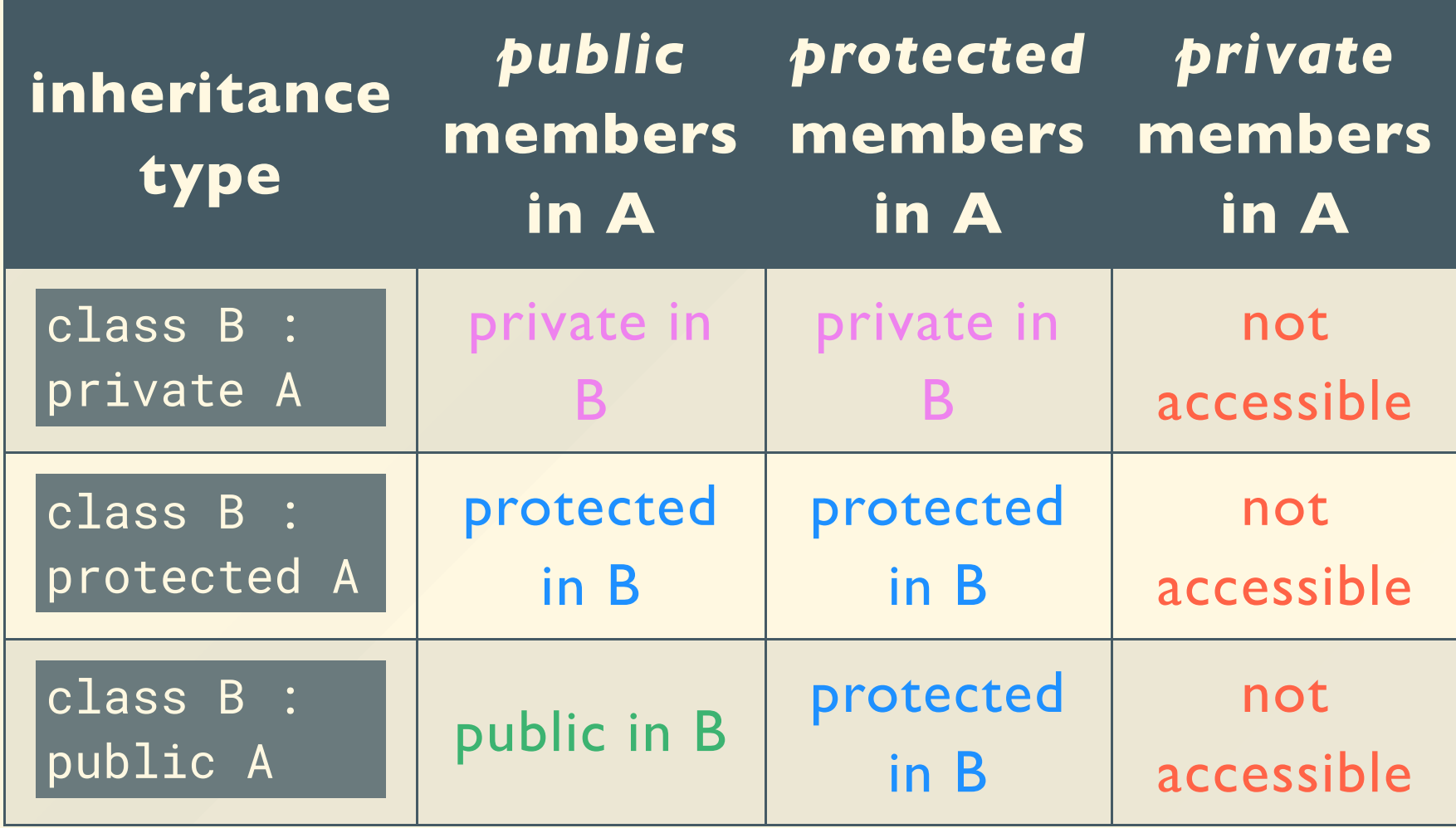
注意:
- 基类的
private成员始终不能被派生类直接访问; - 继承方式只影响基类的
public和protected成员在派生类中的访问级别; - 最常见、最符合
is-a语义的是public继承。
public 继承
class B : public A {};映射规则:
A的public成员,在B中仍是public;A的protected成员,在B中仍是protected;A的private成员,在B中仍不可直接访问。
这是最自然的 is-a 关系。
例子:
class A {public: void pub() {}protected: void prot() {}private: void priv() {}};
class B : public A {public: void test() { pub(); // 对 prot(); // 对 // priv(); // 错 }};
int main() { B b; b.pub(); // 对:public 继承后仍然 public // b.prot(); // 错:类外不能访问 protected}protected 继承
class B : protected A {};映射规则:
A的public成员,在B中变成protected;A的protected成员,在B中仍是protected;A的private成员仍不可直接访问。
例子:
class A {public: void pub() {}protected: void prot() {}};
class B : protected A {public: void test() { pub(); prot(); }};
int main() { B b; // b.pub(); // 错:现在 pub 在 B 外部看来已经不是 public 了}protected 继承可以让派生类继续使用基类能力,但不把基类接口公开给外部。
private 继承
class B : private A {};映射规则:
A的public成员,在B中变成private;A的protected成员,在B中也变成private;A的private成员仍不可直接访问。
例子:
class A {public: void pub() {}protected: void prot() {}};
class B : private A {public: void test() { pub(); prot(); }};
int main() { B b; // b.pub(); // 错:对外已经变成 private 了}private 继承更偏向实现复用,不表达自然的 is-a 关系。外部不能把 B 当作 A 使用。
Public inheritance、LSP 与 Upcasting
替换原则 LSP
Public inheritance should imply substitution. 如果
B is-an A,那么任何需要A的地方都应该可以使用B。
这就是 Liskov Substitution Principle(LSP,里氏替换原则)。
如果:
class Manager : public Employee { // ...};那么理论上:
- 任何要求
Employee的函数; - 都应该可以传入
Manager对象。
例子:
#include <iostream>#include <string>using namespace std;
class Employee {public: Employee(string name) : m_name(std::move(name)) {} const string& get_name() const { return m_name; }protected: string m_name;};
class Manager : public Employee {public: Manager(string name, string title) : Employee(std::move(name)), m_title(std::move(title)) {}private: string m_title;};
void print_employee_name(const Employee& e) { cout << e.get_name() << '\n';}
int main() { Manager m("Bill", "CTO"); print_employee_name(m); // 对:Manager 可以当 Employee 用}Upcasting:上转型
Upcasting 指:
把派生类对象当成基类对象来看待。
它通常发生在:
- 基类指针;
- 基类引用。
例如:
Manager pete("Pete", "444-55-6666", "Bakery");Employee* ep = &pete; // UpcastEmployee& er = pete; // Upcast这里:
pete的真实类型是Manager;ep的静态类型是Employee*;er的静态类型是Employee&;- 通过
ep/er使用对象时,只能看到Employee接口视角。
上转型只对引用和指针自然成立,因为它们仍然指向 / 引用原来的对象。
引用 / 指针上转型与按值切片
指针上转型
Manager pete("Pete", "444-55-6666", "Bakery");Employee* ep = &pete;ep 指向的实际对象仍然是 Manager,只是当前通过 Employee* 视角访问。
引用上转型
Employee& er = pete;er 是 pete 的一个基类引用视角,没有复制对象。
按值赋值会发生 object slicing
如果写成:
Employee e = pete;这不是上转型引用,而是创建了一个新的 Employee 对象副本。此时会发生 object slicing(对象切片):
Manager中属于Employee的基类部分被拷贝出来;Manager自己新增的m_title等字段被切掉;- 得到的是一个独立的
Employee对象。
例子:
#include <iostream>#include <string>using namespace std;
class Employee {public: Employee(string name) : m_name(std::move(name)) {} void print() const { cout << "Employee: " << m_name << '\n'; }protected: string m_name;};
class Manager : public Employee {public: Manager(string name, string title) : Employee(std::move(name)), m_title(std::move(title)) {}
void print_manager() const { cout << "Manager: " << m_name << ", " << m_title << '\n'; }private: string m_title;};
int main() { Manager m("Alice", "Director");
Employee& ref = m; // 上转型,还是同一个对象 ref.print();
Employee copy = m; // 切片,产生一个独立的 Employee 子对象副本 copy.print();}总结:
| 写法 | 是否复制对象 | 是否保留完整 Manager 对象 | 结果 |
|---|---|---|---|
Employee* p = &m; | 否 | 是 | 指针上转型 |
Employee& r = m; | 否 | 是 | 引用上转型 |
Employee e = m; | 是 | 否 | 对象切片 |
上转型后的静态绑定与动态绑定
Lose type information of the object:
ep->print(cout); // The base print() is called
意思是:
- 通过基类指针 / 引用访问时,编译器当前只看到基类接口;
- 如果函数不是
virtual,调用会按照静态类型绑定; Employee* ep调用ep->print(cout)时,会调用Employee::print。
非 virtual:静态绑定
#include <iostream>using namespace std;
class Employee {public: void print() const { cout << "Employee::print\n"; }};
class Manager : public Employee {public: void print() const { cout << "Manager::print\n"; }};
int main() { Manager m; Employee* p = &m;
p->print(); // 输出 Employee::print}原因:
p的静态类型是Employee*;print()不是 virtual;- 编译器按静态类型决定调用
Employee::print()。
virtual:动态绑定
如果想让基类指针 / 引用根据对象真实类型调用派生类版本,需要使用 virtual。
#include <iostream>using namespace std;
class Employee {public: virtual void print() const { cout << "Employee::print\n"; } virtual ~Employee() = default;};
class Manager : public Employee {public: void print() const override { cout << "Manager::print\n"; }};
int main() { Manager m; Employee* p = &m; p->print(); // 输出 Manager::print}补充:
virtual表示允许运行时动态分派;override表示这个函数确实覆盖了基类虚函数;- 如果一个类准备用作多态基类,析构函数通常也应该声明为
virtual。
Name hiding:同名函数隐藏
问题现象
如果派生类重新定义了一个同名成员函数,基类中其他同名重载版本可能会被隐藏。
例子:
class Employee {public: void print(ostream& out) const; void print(ostream& out, const string& msg) const;};
class Manager : public Employee {public: void print(ostream& out) const;};此时:
Manager bill("Bill Smith", "666-55-1234", "ImportantPerson");bill.print(cout, "Employee:"); // Error -- hidden!原因:
Manager中声明了同名函数print;- 名字查找先在
Manager作用域中找到print; - 找到后,基类
Employee中同名重载集合被挡住; - 编译器只在
Manager::print这一组中匹配参数; Manager::print(ostream&)不能接受两个参数,所以报错。
关键结论:
派生类中的同名函数会隐藏基类中整个同名重载集合。
它不是只隐藏“同参数列表”的版本。
问题代码
#include <iostream>using namespace std;
class Employee {public: void print(ostream& out) const { out << "Employee base print\n"; }
void print(ostream& out, const string& msg) const { out << msg << '\n'; print(out); }};
class Manager : public Employee {public: void print(ostream& out) const { out << "Manager print\n"; }};
int main() { Manager m; // m.print(cout, "hello"); // 错:被 name hiding 挡住了}修复方式:using Base::func;
可以在派生类中把基类同名重载重新引入当前作用域:
class Manager : public Employee {public: using Employee::print; // 把基类同名重载重新引入当前作用域
void print(ostream& out) const { out << "Manager print\n"; }};此时:
int main() { Manager m; m.print(cout); // 调用派生类版本 m.print(cout, "hello"); // 调用基类重载版本}总结:
| 情况 | 结果 |
|---|---|
派生类定义同名函数,但没有 using Base::func; | 基类同名重载集合被隐藏 |
派生类写 using Base::func; | 基类同名重载重新参与重载解析 |
组合 vs 继承:设计判断
适合组合的情况
如果可以说:
A has a B
就优先考虑组合。
例子:
SavingsAccount has a PersonSavingsAccount has a CurrencyCar has an engineEmployee has a supervisor(通常通过引用 / 指针)
组合强调:
- 拥有;
- 包含;
- 使用;
- 内部实现。
适合继承的情况
如果可以说:
A is a B
才考虑继承。
例子:
Manager is an EmployeeStudent is a PersonProfessor is a Person
继承强调:
- 类型扩展;
- 接口复用;
- 可以被当作基类使用;
- 满足替换原则。
警惕为了实现复用而滥用继承
Effective C++ Item 38 的核心观点:
有时候两个类之间实现上很像,但语义上并不满足
is-a。
经典例子:
class Set : public std::vector<int> { // 很可疑};问题:
vector允许重复元素;Set通常要求元素唯一;- 所以
Set is-a vector语义不成立。
更合理的关系:
class Set {private: std::vector<int> data;};即:
Set has-a vector;Set is implemented in terms of vector;vector只是Set的内部实现细节。